Pickleball Spin: Why Surface Roughness Isn't Everything
Running your hand over a paddle can tell you how the surface feels, but not how much spin you will produce. To understand spin, you need to look at the interaction between the ball and paddle as well as the motion of the stroke.
Roughness and friction are not the same thing
Roughness describes surface texture. Friction describes how the surface interacts with the ball during contact. A face that feels rougher does not necessarily produce more rotation on every shot. Finish and impact conditions matter, not only the texture you feel with your fingers.
Your stroke is part of the equation
Paddle path and speed, face angle, and the incoming ball's speed and spin all change the outcome. That is why two players can produce different spin with the same paddle.
To practice topspin, start with a controlled upward motion and aim for repeatable contact. Increase speed only when you can keep the ball trajectory inside the court. A rough surface does not replace technique.
What about the core, deformation and absorption?
The ball and paddle deform during impact. The word pocketing is sometimes used to describe the sensation that the ball sinks into or is carried by the face. That sensation alone does not measure contact time or spin.
The core contributes to the response of the full paddle and to how impact feels. But absorbing more energy does not guarantee more spin. You also cannot conclude that a softer core will produce more RPM without testing the complete paddle under comparable conditions.
Face material does not tell the whole story either
Kevlar and carbon describe construction materials; their names are not spin ratings. Surface finish, resin and the complete structure matter when comparing paddles. Avoid deciding from a label or a hand-feel test alone.
How we approach it in INVICTA V
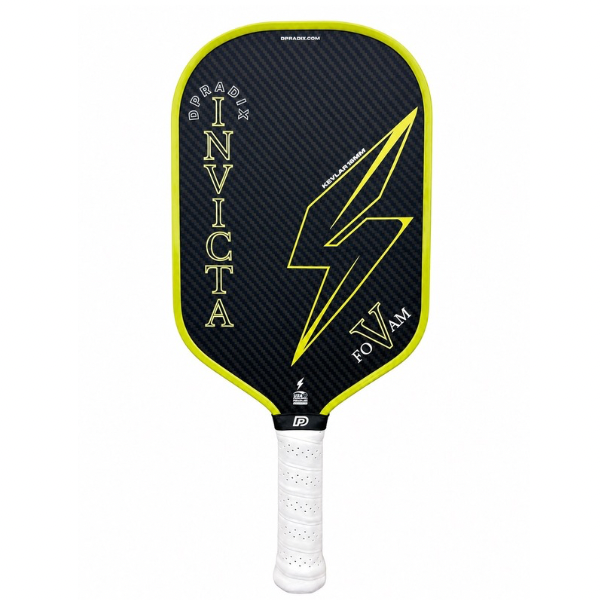
INVICTA V combines a Kevlar face, EPP foam center and elastic TPE perimeter in a 16 mm construction. This is a design choice intended to create a particular response and playing feel. We do not present that combination as a guarantee of more spin or publish an RPM figure without a specific test.
When trying it, use the same ball and alternate topspin drives with flatter shots toward the same target. Consider repeatability, depth and confidence as well as visible rotation.
Explore INVICTA V and read our guide to the EPP core and TPE perimeter.
Technical reading: Tennis Warehouse University spin experiments and its experimental study of elastic surfaces. The latter examines the contact surface and does not demonstrate that an internal TPE perimeter creates the same effect. Neither is an INVICTA V test.